How to Manage RO AMC Customers and Service Renewals
AMC is the steadiest income an RO business has — if visits happen on time and contracts renew. How to set up RO AMC records, plan filter-change visits, track expiry and renew before customers drift away.
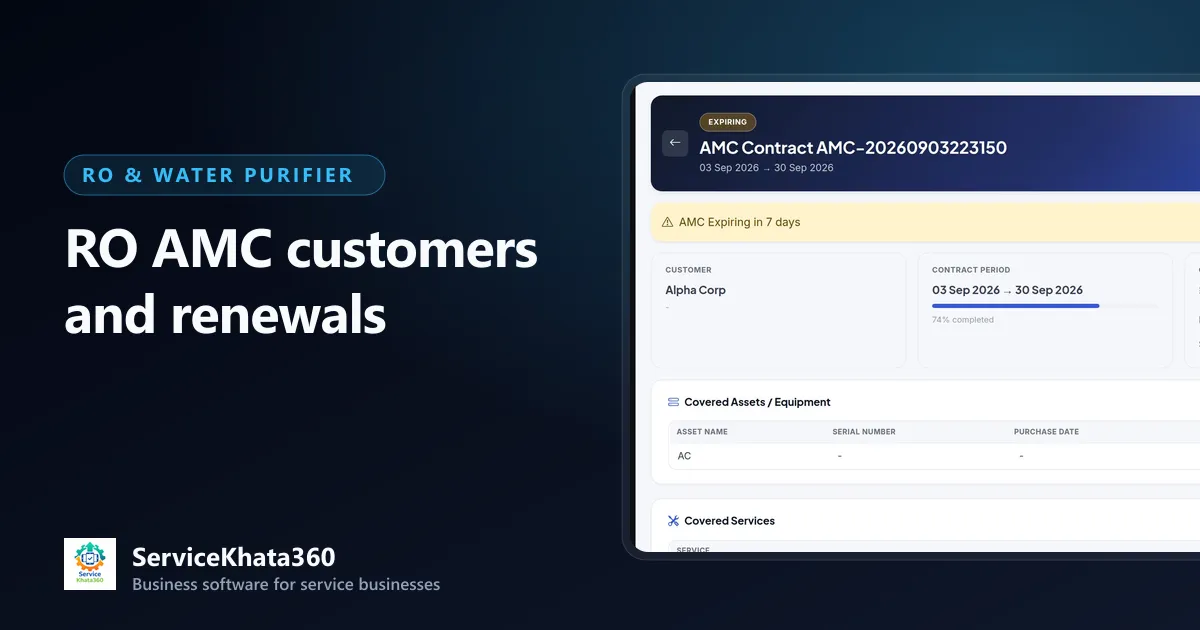
For an RO business, AMC is predictable income. A customer pays once a year, you visit on a schedule to change filters and check the machine, and the customer calls you — not a competitor — when something goes wrong. But an AMC only earns money if two things happen: the scheduled visits actually take place, and the contract renews when it ends. This guide covers how to set up RO AMC records, plan service visits, track expiry and handle renewals without losing contracts along the way.
Decide what your RO AMC includes
Most AMC disputes start with "I thought that was covered". Before you manage AMC customers well, be clear about what you are selling. RO businesses commonly offer some version of:
- Service-only AMC — scheduled visits, cleaning, TDS checks and labour; filters and parts charged separately.
- AMC with filters — scheduled visits plus routine consumables such as sediment and carbon filters; membranes, pumps and electrical parts charged separately.
- Comprehensive AMC — most parts included, usually with clear exclusions such as physical damage, electrical faults from voltage problems or the storage tank.
- Commercial AMC — offices, schools, clinics and societies with larger units or several purifiers and more frequent visits.
Whatever you offer, write the inclusions, exclusions, number of visits and response time into the contract. Prices and inclusions are your commercial decision; the record keeps everyone honest.
What every RO AMC record should contain
- Customer name, mobile number and address
- Contract start and end date
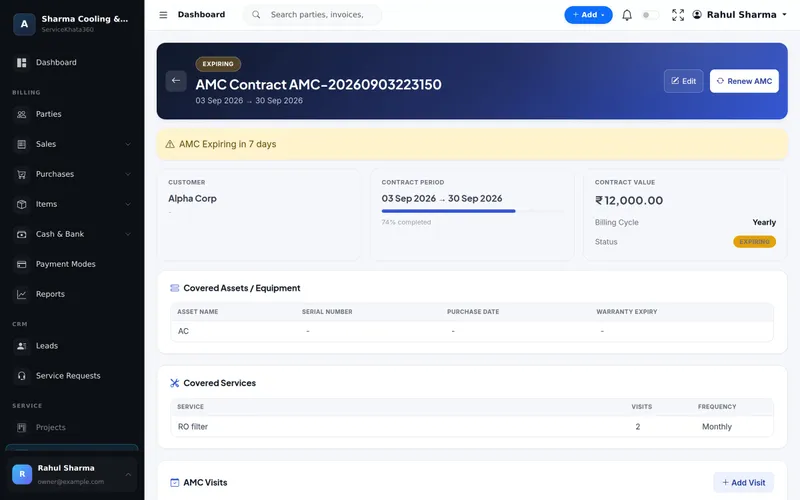
- Contract value and billing cycle — one-time, monthly, quarterly or yearly
- Covered units — brand, model and serial number of each purifier, with warranty expiry if you sold it
- Covered services — for example "RO filter change, 2 visits" or "general service, 4 visits, quarterly"
- Exclusions and any special terms
Covered units matter more than they seem. If a customer has one purifier in the kitchen and another in the office downstairs, the contract should say which one is included.
Plan the visits at the start of the contract
The most common AMC failure is not a lost customer — it is a visit that never happened. When a contract starts, plan every visit in the contract period rather than waiting for the customer to call. Spread visits sensibly across the year: water quality and usage change with the season, and areas with high-TDS borewell water usually need more frequent filter changes than areas on municipal supply.
Each week, look at the visits due in the next seven days and assign them to technicians. After each visit, record:
- Status — completed or skipped (with a reason: customer not home, house locked, rescheduled)
- What was done — filters replaced, membrane cleaned, TDS reading, leakage checked
- Any recommendation — "membrane output low, likely due next visit"
These notes are what you will show the customer at renewal time.
Complaints from AMC customers
When an AMC customer calls with a problem between scheduled visits, log it as a service request against the same customer and check the contract before sending a technician. Covered work gets priority; parts outside the contract should be quoted before replacement. Keeping complaints on the customer record also shows which contracts cost you more than they earn — information you need when you price the renewal. Our guide to managing RO service calls covers the complaint side in detail.
Billing AMC on the right cycle
A yearly AMC paid upfront is simple. Monthly and quarterly AMCs are easy to miss. Match invoices to the contract's billing cycle and check each month which AMC invoices are due. Record payments against them so you know whether a customer is up to date before the next visit.
Expiry tracking: know what is ending
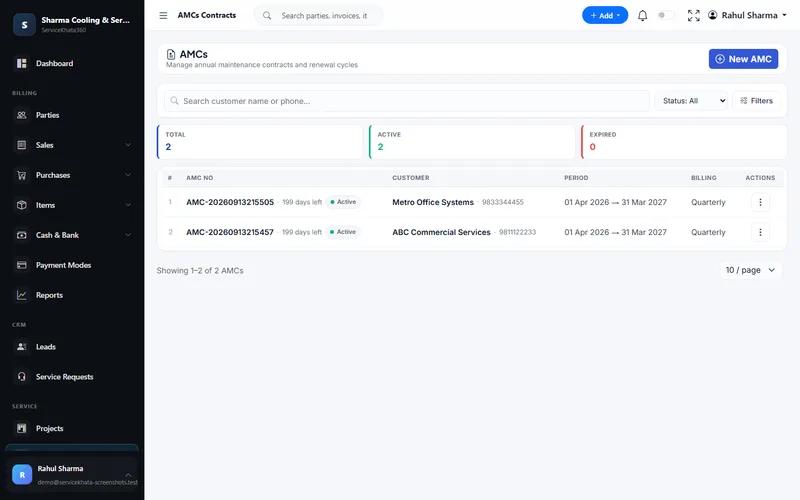
An AMC that expires without a conversation is usually lost. Keep a running list of contracts by days left, and treat anything inside 30–45 days as renewal work, not something to remember later.
A simple renewal routine
- Every week, list contracts expiring in the next 30–45 days.
- For each one, review the year: visits completed, complaints attended, parts replaced.
- Decide the renewal price — revise it if the customer added a purifier or the site needed more visits than planned.
- Call the customer with a short summary: "We visited four times, changed filters twice and attended one complaint."
- Send the renewal quotation the same day.
- On approval, renew the contract and plan the next term's visits straight away.
The summary call is what makes renewal easy. Customers rarely argue with a clear record of work done.
Turning one-time customers into AMC customers
Your best AMC prospects are customers you have already served:
- Customers who just had a repair or membrane replacement
- Customers who bought a purifier from you and whose warranty is ending
- Customers who call for a filter change every year without a contract
A list of customers with service history but no active AMC is one of the most useful lists an RO business can keep.
Common RO AMC mistakes
- Selling AMC without listing which purifiers are covered.
- Waiting for the customer to call before scheduling a visit.
- No written record of completed visits, so renewal becomes an argument.
- Renewing at the same price every year regardless of how much work the site needed.
- Including "all parts" without exclusions, then losing money on a pump or membrane.
How ServiceKhata360 handles RO AMC
In ServiceKhata360, each AMC contract records its period, value and billing cycle (one-time, monthly, quarterly or yearly), the covered assets with serial number and warranty expiry, and covered services with the number of visits and frequency. AMC visits are added to the contract with a date, technician and a Pending, Completed or Skipped status. Every contract shows days left; contracts close to their end date show as Expiring with an alert, and Renew AMC starts the next term from the same contract. AMC reports cover status, expiry, service due, customer and technician summaries.
Renewal reminders can also go to customers automatically on WhatsApp: once your WhatsApp number is linked to ServiceKhata360 (a one-time QR scan) and the AMC renewal reminder workflow is switched on, customers receive a reminder on the days you choose before their AMC expires, once per contract. Visits are added and assigned by your team; the reminder workflow covers renewals, not visit scheduling.
See how AMC connects to complaints, technicians and billing on the RO service management software page, or read about the AMC management module.
Frequently Asked Questions
How many visits should an RO AMC include?
Should filters and membranes be included in an RO AMC?
Can ServiceKhata360 remind customers before their AMC expires?
Does ServiceKhata360 schedule AMC visits automatically?
Looking for one system to manage your RO service business?
See ServiceKhata360 with your own workflow — complaints, technicians, filter-change visits, billing and AMC renewals.