How AC Service Companies Can Track Customer Complaints
From "AC not cooling" to "water leaking" — how to log AC complaints consistently, set priorities and due dates, spot repeat complaints and close every ticket properly.
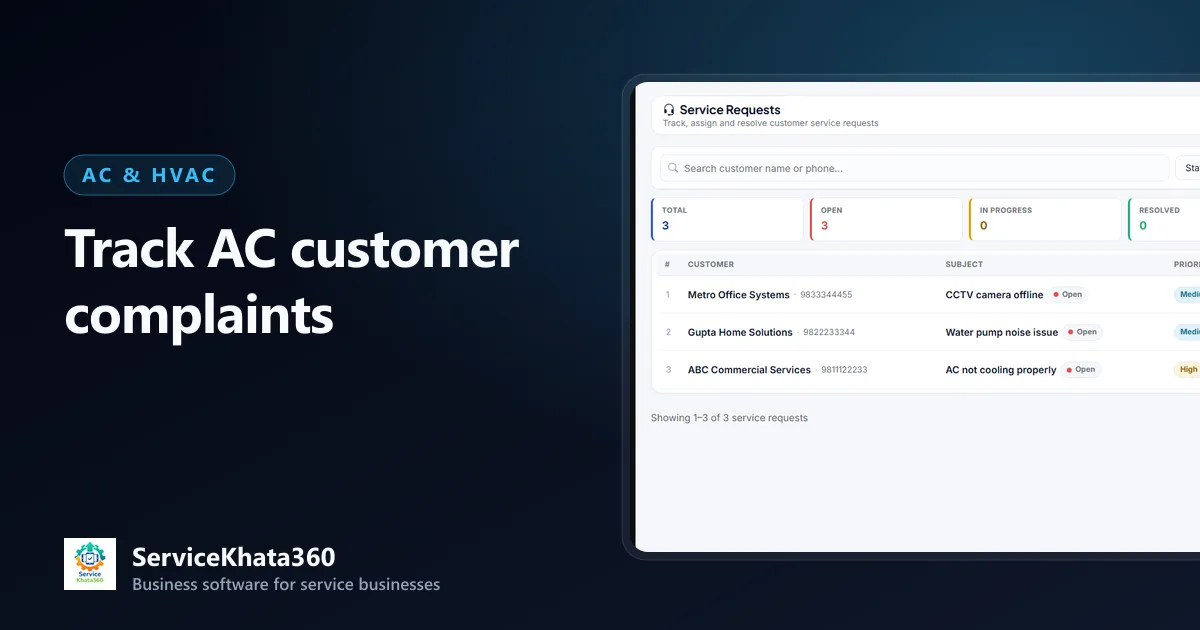
Every AC service company says it attends complaints quickly. The difference between a company that actually does and one that does not is rarely the technicians — it is whether complaints are recorded, owned and followed to closure. This guide covers how to build a complaint process that works even in the peak of summer.
Why complaints get lost
- They arrive on several phones — the office number, the owner's mobile, a technician's WhatsApp.
- Details are incomplete — "AC not working, Sector 12" — so the technician calls back for more.
- Nobody owns them between the call and the visit.
- "Will come tomorrow" is promised, but tomorrow is not written down anywhere.
- Closed complaints leave no history, so a repeat problem looks like a new one.
Step 1: A standard intake
Whoever takes the call should capture the same details every time:
- Customer name, phone and full address
- Unit — brand, type (split, window, cassette), tonnage, location ("bedroom 2")
- Symptom in the customer's words — "not cooling", "water dripping inside", "error E4", "noise from outdoor unit"
- Under AMC, under warranty, or chargeable
- Preferred visit time
Good intake saves a wasted visit. "Water dripping inside" usually means a drain issue; "not cooling and outdoor fan not running" points to capacitor or fan motor. The technician can carry the right part.
Step 2: Priority and due date
Use four levels and agree what they mean:
- Critical — server room, clinic, or commercial site with no cooling
- High — AMC customer or complete breakdown in peak heat
- Medium — reduced cooling, water leakage, noise
- Low — remote control, minor adjustment, general query
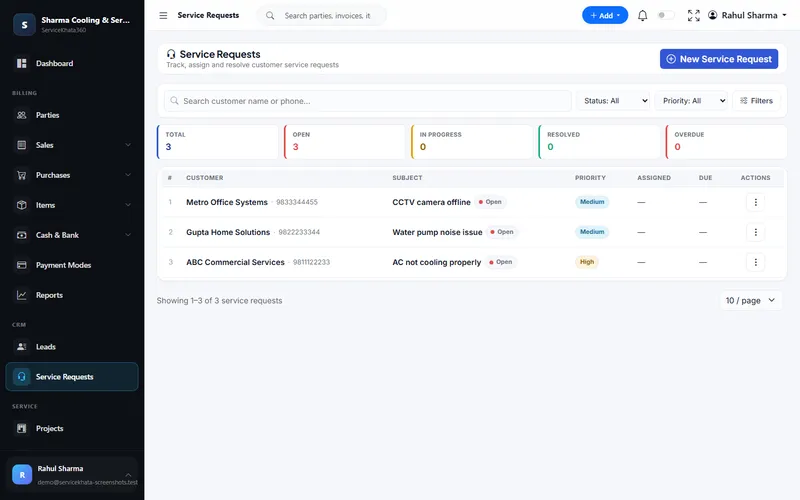
Every complaint gets a due date. Overdue complaints should be visible at a glance, not discovered when the customer calls back angry.
Step 3: Acknowledge the customer
An immediate acknowledgement — "Your complaint is registered, our technician will contact you" — reduces repeat calls more than anything else. If it can be sent automatically, even better.
Step 4: Assign and track
Assign the complaint to a technician by area and skill. Track it through visit, diagnosis, waiting for parts and resolution. For dispatch practices, see how to assign AC service calls to technicians.
Step 5: Record what was found and done
A closed complaint should say what the cause was and what was done — "capacitor replaced", "drain line cleaned", "gas leak at flare joint fixed, gas topped up". This is the history the next technician will rely on.
Step 6: Resolve, confirm, then close
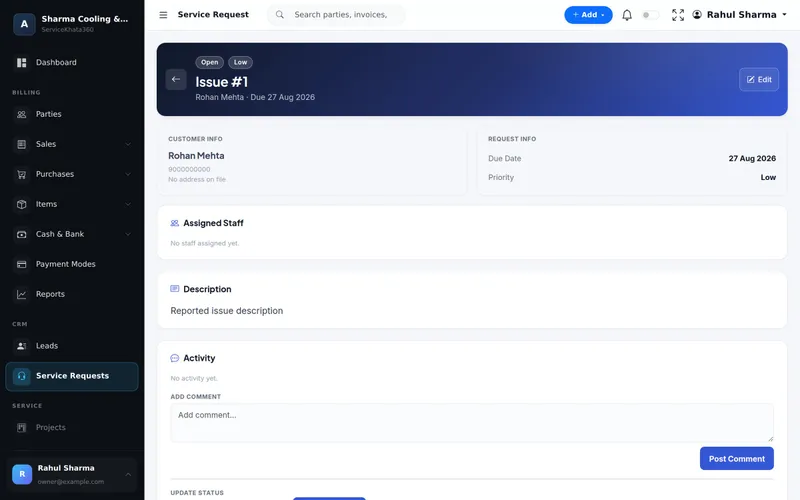
Separate resolved (technician fixed it) from closed (customer confirmed, billing done). This simple split stops complaints being closed before the customer agrees, and stops parts going unbilled.
Spot repeat complaints
When complaints are recorded against the customer, repeat problems become visible. Two complaints on the same unit within a month should get a senior technician, not a routine visit. Repeated gas top-ups usually mean an unrepaired leak. Repeat complaints are also a strong signal at AMC renewal — see managing AC AMC renewals.
What to review weekly
- Overdue complaints and the reason for each
- Complaints waiting for parts for more than two days
- Average time from complaint to resolution, by technician
- Customers or units with repeat complaints
How ServiceKhata360 tracks AC complaints
Each complaint in ServiceKhata360 is a service request with subject, priority (Low, Medium, High, Critical), assigned technician, due date and status — Open, In Progress, Resolved or Closed — with an activity log for comments and status updates. Requests sit on the customer record alongside invoices, payments and AMC contracts. With your WhatsApp number linked, workflows can acknowledge a new complaint and send technician details on assignment. Service reports cover status, priority, assignee, ageing and resolution.
Learn more about complaint management, or see the full AC & HVAC service workflow.
Frequently Asked Questions
What details should be taken when an AC complaint is logged?
What is the difference between Resolved and Closed?
How do I spot repeat complaints?
Looking for one system to manage your AC service business?
See ServiceKhata360 with your own workflow — enquiries, estimates, technicians, service calls, billing and AMC.